
Unlike traditional slots that spin to a predetermined outcome, Chicken Road 2 hands control of volatility and exit timing directly to the player. Four difficulty tiers adjust lane count and traffic density, letting you calibrate risk before each round begins. Multipliers compound from a modest 1.01× on the first lane to a peak single-step factor of 1.19× by lane six, with circular manhole markers tracking your progress in real time. A live wins feed streams payouts from other participants, reinforcing the social dimension of a game that operates entirely within your browser. We tested every difficulty tier, explored the keyboard shortcut, examined the interface and assessed whether the sequel justifies its place alongside InOut's growing catalogue of crash-style mini-games.
Chicken Road 2: key facts
| Provider | InOut Games |
|---|---|
| Type | Browser-based gambling game (crash mechanic) |
| RTP | Not disclosed |
| Volatility | Player-adjustable (Easy / Medium / Hard / Hardcore) |
| Min / max bet | £0.50 minimum (interface shows £0.50, £1, £2, £7 presets) |
| Max win | Not specified by provider |
| Mobile | Yes (browser-based, resolution-adaptive) |
| Demo | Yes |
A tightly executed crash game that rewards timing and nerve, offering genuine player agency through adjustable difficulty and instant cashout.
What is Chicken Road 2?
Chicken Road 2 belongs to the crash-game genre, a category defined by rising multipliers and player-controlled exits rather than fixed reels or paylines. Your avatar—a meticulously rendered white chicken complete with crimson comb, orange beak and yellow legs—begins at the base of a multi-lane roadway. Turquoise vehicles sweep horizontally across the screen; your task is to advance through successive lanes without colliding. Each successful crossing applies a fixed multiplier to your wager, and these factors compound as you progress. A circular manhole icon on every lane displays your current total, allowing you to monitor earnings at a glance.
InOut positions this title as the sibling to the original Chicken Road, retaining the four-tier difficulty structure (30, 25, 22 and 18 lanes) and the identical multiplier sequence. The distinction lies in presentation: altered background scenery, revised traffic choreography and a different graphical skin. The game defaults to Medium difficulty, which presents 25 lanes and strikes a midpoint between steady accumulation and meaningful hazard. A live wins feed occupies the header strip, streaming recent payouts alongside an online player count; during our tests the counter hovered around 23,000 concurrent users. This social layer distinguishes browser-based crash games from isolated slot sessions, creating a shared sense of risk and reward.
The interface supports English, prices stakes in pounds sterling and runs at an estimated resolution of 1920×1080, scaling gracefully to smaller viewports. No download or plugin is required; the game launches directly within any modern browser. A settings menu unlocks a keyboard shortcut—pressing the Space bar advances your chicken through lanes—which suits players who prefer rhythmic, two-handed input over mouse clicks. The combination of immediate feedback, transparent multiplier logic and adjustable volatility gives Chicken Road 2 broad appeal, accommodating cautious newcomers and adrenaline-seeking regulars within the same framework.

How to play Chicken Road 2
1: Select your stake and difficulty
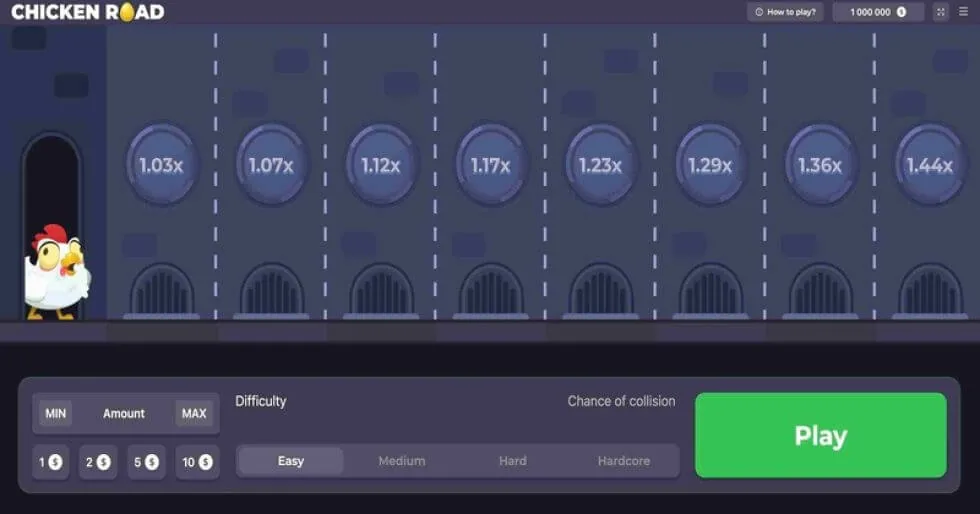
Four circular bet buttons occupy the lower control strip, offering presets of £0.50, £1, £2 and £7. Click your preferred amount; the selected button gains a subtle highlight. Immediately above, the difficulty menu presents Easy, Medium, Hard and Hardcore. Medium is preselected by default and recommended for first-time players. Easy extends the roadway to 30 lanes with sparser traffic, granting more breathing room to accumulate multipliers. Hard restricts you to 22 lanes and tightens vehicle spacing, whilst Hardcore compresses the challenge into just 18 lanes under maximum pressure. Your choice governs lane count and traffic density but does not alter the multiplier values themselves—1.01× through 1.19× remain constant across all tiers. Once satisfied, press the prominent green 'Play' button to commit your wager and spawn your chicken at the starting line.
2: Navigate lanes and watch multipliers compound
Your white chicken appears at the base of the screen, standing on a grey shadow with a gentle idle animation looping every two seconds. Turquoise cars glide horizontally across each lane at varied speeds; timing your movement between these vehicles is the crux of gameplay. Click to advance one lane forward, or activate the 'Space to spin and go' setting in the menu to use the Space bar instead. Each successful crossing applies the next multiplier in the sequence—1.01× for lane one, escalating to 1.19× by lane six—and these factors compound cumulatively. A circular manhole icon on every lane displays your running total, rendered with concentric rings and spoke patterns for clarity. The roadway itself features altered scenery compared to the original Chicken Road: revised lane markings, different background elements and a distinct colour palette that reinforces the sequel identity.
3: Cash out or risk advancing further
At any moment before clicking to enter the next lane, you may withdraw your accumulated winnings by pressing the cashout control. This locks in your current multiplier and credits your balance, displayed in the interface with a gold coin icon bearing the number 8 and space-separated thousands for legibility. If a turquoise car strikes your chicken mid-crossing, the round ends immediately and your wager is lost—there are no partial refunds or second chances. The tension escalates with each lane: early exits secure modest profits, whilst deeper runs chase exponential growth at the cost of mounting collision risk. The live wins feed continues streaming payouts from other participants throughout your session, providing social proof that successful cashouts occur regularly. Once a round concludes—whether by cashout or collision—you return to the stake-selection screen to begin the next attempt.
How much can you win?
InOut does not publish a maximum win ceiling for Chicken Road 2, a common trait among crash-style games where theoretical limits depend on stake size, difficulty tier and how deep into the roadway a player advances without collision. The multiplier sequence begins at 1.01× for the first lane and peaks at 1.19× per lane by the sixth crossing; these factors compound, meaning a six-lane run on Medium difficulty would yield approximately 1.01 × 1.04 × 1.07 × 1.10 × 1.14 × 1.19 ≈ 1.68× your original stake. Extending the calculation across all 25 lanes on Medium—or the full 30 lanes on Easy—produces exponentially larger multiples, though the likelihood of collision rises sharply with each additional lane traversed.
To illustrate practical outcomes, consider a £1 wager on Medium difficulty. Cashing out after five lanes might return £1.40 to £1.50, a conservative but achievable profit. Reaching lane fifteen could multiply your stake by a factor of three to five, depending on the exact multiplier progression. Pushing beyond lane twenty enters high-risk territory: collision probability increases substantially, yet successful navigation delivers multiples well into double digits. Hardcore mode compresses the roadway to 18 lanes, concentrating hazard and multiplier growth into a narrower window. The absence of a disclosed RTP figure means players must rely on session observation and published multiplier tables rather than certified return percentages.
- Multipliers compound lane by lane, starting at 1.01× and peaking at 1.19× per crossing.
- Early cashouts (lanes 1–5) yield modest, low-risk returns suitable for bankroll preservation.
- Mid-depth runs (lanes 6–15) balance risk and reward, targeting multiples of two to five times your stake.
- Deep runs (lanes 16+) pursue exponential growth but face collision probabilities that rise sharply with each advance.
- Difficulty tier adjusts lane count and traffic density without altering the base multiplier sequence.
- No published maximum win or RTP figure; outcomes depend on player timing, stake size and chosen difficulty.
Strategies and good habits
Set exit thresholds before each round
Emotion and impulse sabotage more crash-game sessions than poor timing. Before clicking 'Play', decide your cashout target—whether a specific multiplier (for example, 2× your stake) or a fixed lane number (say, lane ten). Write this threshold down if necessary, then honour it regardless of how the round unfolds. The live wins feed will tempt you with screenshots of players collecting twenty-fold returns; remember that survivorship bias hides the dozens of collisions that never appear in the stream. Pre-commitment removes the paralysis that accompanies real-time decision-making and prevents the 'one more lane' spiral that erodes discipline. Adjust your threshold between rounds based on session performance, but never mid-round.
Match difficulty tier to session goals
Easy mode's 30 lanes and relaxed traffic suit players seeking steady accumulation or testing new cashout strategies without severe punishment. Medium balances challenge and reward, making it the natural choice for regular play. Hard and Hardcore demand precision timing and accept frequent losses in exchange for compressed, high-intensity rounds. Switching difficulty between sessions—rather than chasing losses by escalating to Hardcore—maintains variety and prevents tilt. If your goal is entertainment over profit maximisation, Easy mode extends playtime per pound wagered. If you prefer adrenaline and accept higher variance, Hardcore delivers that experience. Aligning difficulty with intent, rather than recent results, keeps decision-making rational.
Track your session in a separate notepad
Browser-based games rarely offer granular statistics panels. Open a simple text file or spreadsheet before launching Chicken Road 2 and log each round: stake, difficulty, lane reached, cashout multiplier and net result. After twenty or thirty rounds, patterns emerge—perhaps you consistently profit on Medium but haemorrhage funds on Hardcore, or early cashouts preserve capital whilst deep runs erase gains. Objective data counteracts selective memory, which tends to magnify wins and minimise losses. This habit also enforces cool-down periods between rounds, reducing the mechanical click-and-play rhythm that accelerates bankroll depletion. Responsible gambling requires self-awareness; tracking transforms gut feelings into measurable trends.
Free demo or real money?
Chicken Road 2 provides demo access without requiring account creation or payment-method entry—a feature InOut highlights explicitly in the game's promotional copy. The demo replicates full functionality: all four difficulty tiers, the complete multiplier sequence, keyboard shortcuts and the live wins feed operate identically to real-money mode. Your balance displays as play currency rather than sterling, but collision mechanics, traffic patterns and cashout logic remain unchanged. This zero-friction trial suits newcomers exploring crash-game mechanics for the first time and experienced players testing exit strategies before committing funds.
Demo mode cannot, however, replicate the psychological pressure that accompanies genuine stakes. The temptation to push 'one more lane' when house money is at risk differs fundamentally from the same decision with real pounds on the line. Emotional discipline—the cornerstone of sustainable crash-game play—only manifests under authentic conditions. Use the demo to internalise timing, memorise multiplier checkpoints and experiment with difficulty tiers, then transition to real money with conservative stakes once confident in your execution. Partner casinos hosting InOut titles typically enforce eighteen-plus age verification and offer deposit limits, session reminders and self-exclusion tools. Engage these features from the outset; crash games reward preparation and punish impulsivity more than any slot reel ever will.
Our opinion
Chicken Road 2 exemplifies what the crash-game genre does well: transparent mechanics, immediate feedback and player agency over volatility and exit timing. InOut's decision to retain the original's four-tier difficulty structure whilst refreshing the visual presentation strikes a sensible balance between familiarity and novelty. The compounding multiplier system is easy to grasp yet deep enough to support varied strategies, from conservative five-lane cashouts to high-wire attempts at twenty-plus crossings. The live wins feed and online player counter inject social context into what might otherwise feel like a solitary exercise in risk management, whilst the keyboard shortcut (Space bar to advance) accommodates players who prefer tactile, rhythmic input.
The absence of a published RTP figure and maximum win ceiling places Chicken Road 2 squarely in the 'trust the provider' category—a stance that may unsettle players accustomed to certified slot percentages but aligns with industry norms for crash-style games. The realistic chicken avatar, complete with anatomical detail and idle animation, adds character without tipping into parody; this attention to presentation elevates the experience above bare-bones competitors. Traffic choreography feels fair rather than arbitrary: collisions stem from mistimed clicks, not hidden algorithms. The game's browser-based nature ensures accessibility across devices without compromise, though mobile players will need steady thumbs and a tolerance for smaller touch targets during high-speed sequences. Chicken Road 2 won't convert slot purists, but it delivers precisely what crash-game enthusiasts seek—clean execution, adjustable difficulty and the thrill of deciding when enough is enough.
👍 Pros
- Four difficulty tiers let you calibrate risk and lane count before each round, offering genuine control over volatility.
- Compounding multipliers (1.01× to 1.19× per lane) are transparent and easy to track via circular manhole progress markers.
- Demo mode requires no account or payment details, providing zero-friction access to full functionality.
- Keyboard shortcut (Space bar) supports faster, more rhythmic play for those who prefer it over mouse input.
- Live wins feed and online player count create a shared, social atmosphere uncommon in solo gambling games.
👎 Cons
- No published RTP or maximum win figure; players must trust provider integrity without certified percentages.
- Traffic patterns and collision detection remain opaque—success feels skill-based, but underlying randomness is undisclosed.
- Limited stake presets (£0.50, £1, £2, £7) may not suit all bankroll sizes; custom entry would improve flexibility.
- Visual distinction from the original Chicken Road is modest—revised scenery and layout, but core identity remains similar.
Frequently asked questions
Can I play Chicken Road 2 on my phone?
Yes. Chicken Road 2 runs entirely within your browser, adapting to mobile viewports without requiring a dedicated app. Touch controls replace mouse clicks, and the interface scales to smaller screens. The keyboard shortcut (Space bar) obviously won't function on touchscreen devices, but standard tap input works reliably. Ensure a stable connection; any lag during traffic navigation can result in mistimed crossings and collision.
Is Chicken Road 2 provably fair?
InOut does not publish provably fair documentation or seed verification for Chicken Road 2. The term 'provably fair'—common in cryptocurrency gambling—allows players to audit round outcomes using cryptographic hashes. Chicken Road 2 operates as a standard browser-based game; transparency relies on provider reputation rather than user-verifiable algorithms. If cryptographic fairness is a requirement, seek titles that explicitly offer seed checking and hash verification.
What is the difference between Chicken Road and Chicken Road 2?
Both titles share InOut's authorship, the four-tier difficulty structure (30, 25, 22 and 18 lanes) and identical multiplier progression (1.01× to 1.19× per lane). Chicken Road 2 introduces revised scenery, altered traffic patterns and a refreshed visual layout. The core mechanic—navigate lanes, compound multipliers, cash out before collision—remains unchanged. Think of the sequel as a reskin with minor choreography adjustments rather than a fundamental redesign.
How do I know when to cash out?
There is no formula. Each lane crossed increases your multiplier but also raises collision probability. Conservative players exit after five to seven lanes, locking in modest, repeatable profits. Aggressive players push beyond fifteen lanes, chasing exponential growth at the cost of frequent wipeouts. The optimal strategy depends on your bankroll, risk tolerance and session goals. Set a cashout threshold before each round and honour it—discipline beats intuition in crash games.
Does difficulty tier affect the multipliers?
No. The multiplier sequence (1.01× for lane one, up to 1.19× per lane by lane six) remains constant across Easy, Medium, Hard and Hardcore. Difficulty adjusts two variables: total lane count (30, 25, 22 or 18) and traffic density. Higher tiers compress the roadway and increase vehicle frequency, raising collision risk without altering payout factors. Choose difficulty based on how much hazard you want to navigate, not the multipliers themselves.