
Unlike conventional slots where outcomes unfold automatically, Tower Rush hands control entirely to the player. Every floor you add increases your potential win, but a single collapse erases everything accumulated in that round. We tested the game across dozens of sessions at partner casinos, examined its bonus mechanics, and assessed whether the high RTP translates into a fair experience for both cautious climbers and high-stakes risk-takers.
Tower Rush: key facts
| Provider | Galaxsys |
|---|---|
| Type | Crash / Building game |
| RTP | 98.5% |
| Volatility | High |
| Min / max bet | £0.01 / £100 |
| Max win | £10,000 |
| Mobile | Yes |
| Demo | Yes |
Tower Rush delivers transparent, high-RTP crash gameplay with meaningful player control, though variance remains brutal and bonus floors feel too infrequent to shift long-term outcomes.
What is Tower Rush?
Tower Rush belongs to the crash-game family, a category that replaces spinning reels with time-based or progression-based multipliers. In this variant, you build a tower floor by floor, with each successful addition increasing the win multiplier applied to your original stake. The game engine determines in advance when the tower will collapse, but that information remains hidden until you either cash out voluntarily or the structure fails. Your only objective is to exit before the crash, banking whatever multiplier you reached.
Galaxsys designed the game around a fixed 36-floor structure, with each level corresponding to a specific multiplier value. Early floors offer modest returns—often below ×2—while upper tiers can multiply your bet dozens or even hundreds of times. The tension comes from knowing that collapse can occur at any moment, turning a promising climb into a total loss. Provably fair algorithms govern the outcome, meaning the result is mathematically verifiable, though this does not alter the house edge or guarantee favourable runs.
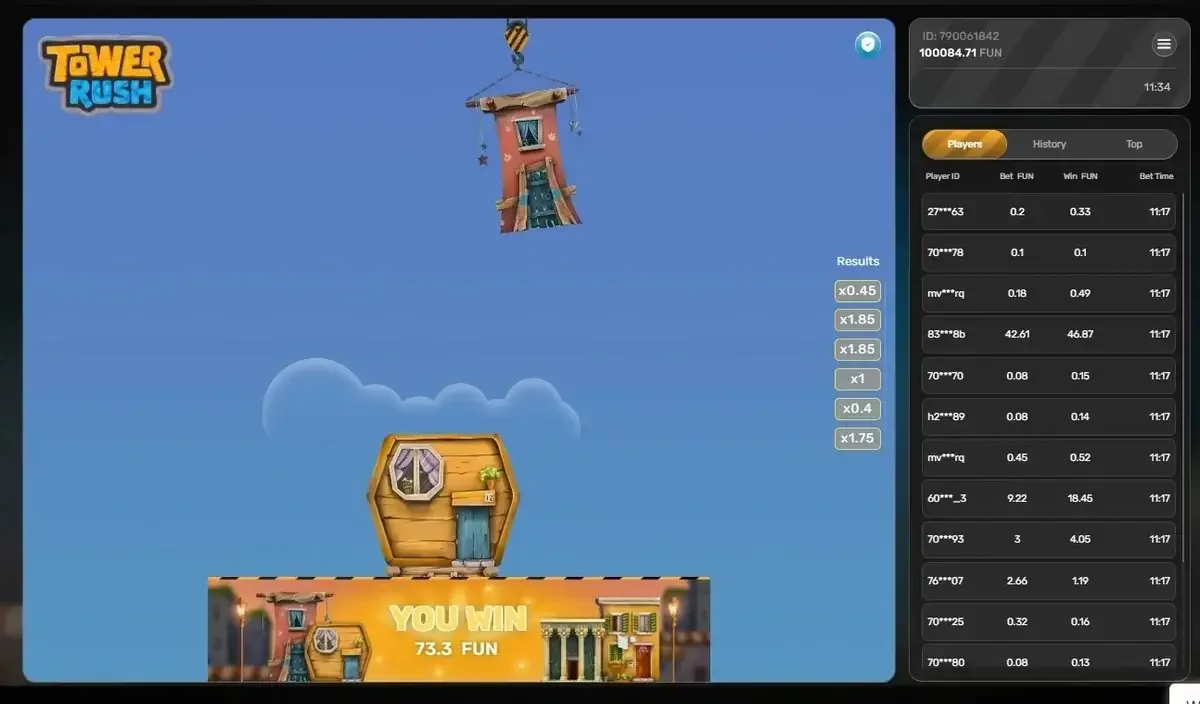
The interface displays your current floor, the active multiplier, and a live feed showing recent player activity. You place a bet, begin the ascent, and watch the multiplier tick upwards as each floor locks in. A prominent cashout button remains available throughout the climb, and the moment you click it, your accumulated winnings transfer to your balance. If the tower collapses before you exit, the round ends and your stake is lost. This binary outcome—cash out or lose everything—defines the entire experience.
How to play Tower Rush
1. Set your stake and start the climb
Select a bet amount between £0.01 and £100 using the stake adjuster. Once you confirm, the tower begins to rise. The first floor appears immediately, and you see the corresponding multiplier applied to your bet. At this point, your potential win is live, and the cashout option becomes active. You can exit after just one floor if you prefer guaranteed small returns, or continue upwards to chase higher multipliers.
2. Add floors and watch the multiplier grow
Each floor you place increases the multiplier according to a predetermined schedule. The game does not use random symbol arrangements; instead, the payout grows systematically as you ascend. Early levels might add fractions of your bet, while middle and upper floors deliver exponential jumps. The visual display shows your current position, the next multiplier threshold, and the total potential win if you cash out immediately. Tension mounts as you climb higher, because the probability of collapse increases alongside the rewards.
3. Cash out or push for the maximum payout
At any moment, you can click the cashout button to secure your winnings. The amount shown on screen transfers instantly to your balance, and the round ends successfully. If you continue climbing and the tower collapses before you exit, you lose the entire stake for that round. The top floor offers the maximum ×10,000 multiplier, but reaching it requires surviving all 36 levels without a collapse—an outcome that occurs rarely due to the game's volatility. Strategic players often set target multipliers in advance and exit when those thresholds are met, rather than chasing the absolute peak.
How much can you win in Tower Rush?
The maximum advertised win stands at £10,000, achieved by staking £100 and cashing out at the ×100 multiplier or staking £1 and reaching ×10,000. In practice, the highest multiplier of ×10,000 appears only if you survive all 36 floors, an event so rare that most players will never witness it in regular play. The 98.5% RTP means that, over thousands of rounds, the game returns £98.50 for every £100 wagered on average. Individual sessions deviate wildly from this figure due to the high volatility inherent in crash mechanics.
Your actual win depends on three factors: the bet size you choose, the floor at which you cash out, and whether the tower collapses before you exit. A £10 stake cashed out at ×5 yields £50, while the same bet lost to a collapse returns nothing. The game does not cap wins artificially below the stated maximum, so reaching intermediate multipliers—×10, ×20, ×50—is possible within a single session if luck and timing align. However, chasing these higher tiers dramatically increases the risk of total loss.
- Minimum win: A £0.01 bet cashed out at the first floor might return £0.02 or less, depending on the initial multiplier. These returns are safe but trivial.
- Mid-range wins: Staking £1 and exiting around ×10 to ×20 delivers £10–£20, a realistic target for players balancing risk and reward.
- Maximum theoretical win: A £100 bet cashed out at ×100 yields £10,000, the game's stated ceiling. Reaching ×10,000 with a £1 bet also hits this cap, though the odds of surviving to that multiplier are vanishingly small.
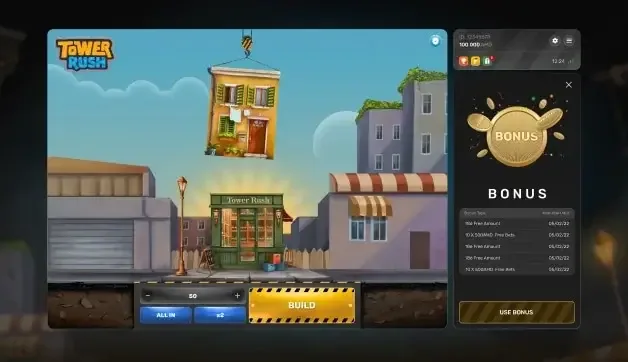
- Bonus floor boosts: Frozen Floor, Temple Floor, and Triple Build can temporarily increase multipliers or protect winnings, but these features trigger infrequently and do not alter the long-term RTP.
Strategies and good habits for Tower Rush
Set a target multiplier and stick to it
Decide in advance at which multiplier you will cash out—×3, ×5, ×10—and execute that plan regardless of short-term results. Chasing higher floors after a few successful rounds invites emotional decision-making, and the tower collapse mechanism punishes indecision. Use the auto-cashout feature to enforce your chosen threshold, removing the temptation to push 'just one more floor'. This approach does not guarantee profit, but it does impose discipline on a game designed to exploit hesitation.
Adjust stake size to match your bankroll
High volatility means long losing streaks occur regularly, even with a 98.5% RTP. Staking too much per round depletes your balance before favourable runs appear. A conservative guideline is to keep individual bets below 1–2% of your total session budget, allowing you to survive 50 or more rounds without going bust. Larger stakes magnify wins but also accelerate losses, so reserve higher bets for moments when you can afford the risk, not when you are chasing losses from earlier rounds.
Ignore live player stats
The game displays recent cashouts and multipliers reached by other players, which some operators present as strategic information. In reality, each round operates independently, and past outcomes have zero predictive value for your next climb. If ten players cash out early, the tower is not 'due' to collapse soon. If someone just reached ×50, your own round follows the same predetermined probability distribution. Use the stats panel for entertainment if you wish, but do not modify your strategy based on what others are doing.
Free demo or real money?
Tower Rush offers a demo mode at most partner casinos, allowing you to test the mechanics with virtual currency before committing real funds. The demo version operates identically to the real-money game, using the same RTP, multiplier schedule, and collapse probabilities. This makes it a valuable tool for experimenting with different cashout thresholds and understanding how quickly variance can swing your balance in either direction. You cannot withdraw demo winnings, but you also cannot lose actual money, which removes the emotional pressure that often leads to poor decisions in live play.
Switching to real money changes nothing about the mathematics—the 98.5% RTP and high volatility remain constant—but it does introduce psychological factors that the demo cannot replicate. The temptation to chase a collapsing tower for one more floor, or the relief of cashing out early and watching the structure fail immediately after, feel different when your own funds are at stake. If you decide to play with real money, treat the demo experience as a rehearsal for discipline rather than a predictor of outcomes. Set your limits in advance, stick to your target multipliers, and accept that the house edge will grind down your balance over time, regardless of short-term wins.
One final note: some casinos restrict bonuses or free spins from being used on crash games like Tower Rush. Check the terms before assuming promotional funds apply, as you may need to clear wagering requirements on slots before accessing this title with bonus money.
Our opinion on Tower Rush
Tower Rush earns its place among the better crash games by offering transparent mechanics, a genuinely high RTP, and meaningful player control. The 98.5% return-to-player figure is verifiable and places it well above most slots, which hover around 96%. The game does not obscure its rules behind complex paytables or hidden modifiers; you know exactly what each floor is worth, and you decide when to exit. This clarity is refreshing in a market crowded with opaque bonus systems and volatile features that promise more than they deliver.
However, the high RTP does not make Tower Rush a favourable bet. The house edge, though smaller than in many alternatives, still ensures that sustained play erodes your bankroll over time. The game's volatility compounds this effect: you can lose ten rounds in a row, then hit a ×20 multiplier that recovers some losses, only to lose the next five rounds again. Bonus floors—Frozen Floor, Temple Floor, Triple Build—appear too rarely to offset these swings, and when they do trigger, their impact is modest rather than game-changing. The maximum ×10,000 payout exists in theory, but reaching it requires a combination of luck so extreme that most players will never see it.
For players who enjoy crash games and understand the risk-reward calculus, Tower Rush is a solid choice. The interface is clean, the mechanics are predictable, and the ability to cash out at any moment provides a degree of agency absent in traditional slots. But do not mistake that agency for control over long-term outcomes. The game is designed to take your money, and over enough rounds, it will. Play for entertainment, set strict loss limits, and never stake funds you cannot afford to lose.
👍 Pros
- Transparent 98.5% RTP, among the highest in the crash-game category
- Clear multiplier structure with no hidden modifiers or complex paytables
- Player-controlled cashout at any moment during the climb
- Demo mode available for risk-free practice and strategy testing
👎 Cons
- Extreme volatility leads to frequent total losses despite high RTP
- Bonus floors trigger too rarely to meaningfully affect session outcomes
- Maximum ×10,000 payout is mathematically possible but practically unattainable for most players
Frequently asked questions
What is the RTP of Tower Rush?
Tower Rush operates at a 98.5% return-to-player rate, meaning that over a large number of rounds, the game returns £98.50 for every £100 wagered on average. This figure applies to all stake sizes and does not change based on your cashout strategy. Individual sessions will deviate significantly from this average due to the game's high volatility.
Can you really win £10,000 in Tower Rush?
The maximum win of £10,000 is achievable by staking £100 and cashing out at ×100, or by staking £1 and reaching the maximum ×10,000 multiplier at the 36th floor. In practice, reaching the highest multipliers is extremely rare due to the probability of collapse increasing as you climb. Most players will see wins in the low-to-mid multiplier range rather than the absolute peak.
How do bonus floors work in Tower Rush?
Bonus floors—Frozen Floor, Temple Floor, and Triple Build—trigger randomly during your climb. Frozen Floor locks your current win total, protecting it temporarily. Temple Floor and Triple Build offer multiplier boosts or other advantages. These features appear infrequently and do not alter the long-term RTP, so they provide occasional relief rather than a consistent strategic edge.
Is Tower Rush provably fair?
Yes, Tower Rush uses provably fair algorithms, meaning the outcome of each round is predetermined and mathematically verifiable. You can check the result against a cryptographic hash to confirm the game did not manipulate the collapse point after you placed your bet. However, provably fair does not mean the game favours the player; the house edge remains constant, and you will lose money over time.
Should I use auto-cashout in Tower Rush?
Auto-cashout is useful for enforcing discipline by exiting at a predetermined multiplier without manual intervention. If you tend to chase higher floors impulsively, setting an automatic threshold—×5, ×10, ×15—removes emotional decision-making from the equation. This does not improve your odds, but it does help you stick to a consistent strategy and avoid catastrophic losses from hesitation.